Showing posts with label General. Show all posts

Friday, July 1, 2016

The Old Timer's Tour of Glacier National Park


It all began as an experiment.

Could a major railroad advertise itself advantageously via the fledgling medium of commercial radio?

The radio series had been on the air for two full years. Response seemed quite good: listener polls regularly showed Empire Builders in the top tier of broadcasts aired on Monday evenings, and even appeared among the leaders across all radio programming; unsolicited fan mail gave anecdotal evidence of a sizable following of devoted listeners; and response was strong whenever a special booklet or giveaway was offered during one of the Empire Builders programs.

Despite indications of the success of this radio advertising campaign, Great Northern Railway management continued to speculate as to the actual positive impact on revenues. Were freight receipts higher, and was there any increase in passenger revenue? And if so, to what degree could such successes be attributed to the singular impact of their radio campaign? After all, while goodwill is an important asset for any company, ultimately they wanted more businesses shipping goods and more people riding Great Northern trains. Increased traffic to Glacier National Park was particularly desired, what with the GN’s hotel subsidiary operating virtually all the lodging facilities in or near the park.

And so, as this grand experiment in radio advertising wound down to its conclusion, one last experiment was attempted. A new question emerged: Would radio listeners respond to an offer to tour Glacier National Park in the company of one of the stars of the Empire Builders radio show?


Passenger Traffic Manager of the Great Northern Railway, A. J. Dickinson.


On January 15, 1931, the GN’s Passenger Traffic Manager, A.J. Dickinson, issued Passenger Traffic Department Circular #16-31. This communique to all General, District, and Traveling Passenger Agents announced that on the Empire Builders broadcast of Monday, January 19th, plans would be unveiled for an “Old Timer’s” Tour of Glacier National Park. The plan was to offer a deluxe 10-day all-expense paid tour of the park, to be hosted by none other than actor Harvey Hays – the “Old Timer.” At the outset, this plan was touted as an experiment to find out what level of interest could be generated for such a tour among the listeners of the weekly radio show. The tour was not advertised via any other vehicle than the opening and/or closing announcements of this weekly 30-minute broadcast. Once the responses to this announcement started coming in, Dickinson and his staff would be able to decide how to proceed with the tour, whether that meant one tour, many tours, or none at all.

The broadcast of January 19th was a drama titled “Nan o’ the Northwest.” The story was set in Glacier National Park. As the program opened, announcer Ted Pearson had an exchange with the Old Timer about the idea of hosting a tour of the park in the summertime. Although Dickinson’s passenger department circular was vague on the timing of any tours, the dialog in the radio show immediately targeted the 4th of July.

For your listening and viewing pleasure, I have created a couple of A/V clips using the original broadcast audio. The first clip has the opening, and the second clip the closing, of the January 19, 1931, broadcast. I’ve paired this audio with an appropriate collection of vintage film footage and associated still images. Please note the audio is in poor shape in places. Also, a few of the still images are not strictly of the same vintage as the broadcast, but should at least provide a nice visual representation of the audio content.


The Old Timer’s invitation to join him on a ten-day trip through Glacier Park proved to be an enticement that many found hard to resist. For a variety of reasons, they picked up paper and pen and wrote to the Old Timer, care of the Great Northern Railway, Chicago, Illinois. Such letters arrived by the bushel. On January 22nd Harold Sims wired Ralph Budd, the president of the Great Northern Railway, to report the early returns.  Sims told Budd that the railroad had already received 341 inquiries to date. During the broadcast of January 26th, the Old Timer lamented he was receiving too many replies – he couldn’t take them all.

Those who wrote to the GN asking about the Old Timer’s Tour were sent a 6-page itinerary of the trip, along with a copy of a
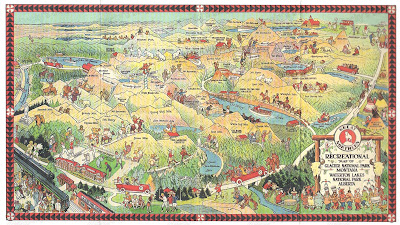
comical map of Glacier Park, illustrated by Joseph Scheuerle. The itinerary laid out the details of what was in store for the tour’s participants from the day they arrived at Glacier Park Station until they departed, ten days later. Here is a synopsis of some of the activities planned:

The Empire Builder at Glacier Park Station. Photo by George Grant.
Courtesy National Park Service, West Glacier, Montana.

Day 1 (July 1):    Arrive Glacier Park Station at 12:15pm; eat lunch; drive in tour coaches up to Two Medicine Chalets; ride across Upper Two Medicine Lake on the launch “Rising Wolf” and take a short hike to see Twin Falls. On the return drive, the coaches stop for another short hike to see Trick Falls. Dinner at Glacier Park Hotel; evening entertainment by Two Guns White Calf and fellow Blackfeet Indians (with a few ceremonial inductions into the Blackfeet tribe); remainder of the evening at “Mike’s Place” in the town of Glacier Park Station.

Day 2 (July 2):    Breakfast at the hotel; depart at 8:15am for a 55-mile tour coach trip to Many Glacier Hotel. Lunch at hotel; short saddle horse trip to see Grinnell Lake; dinner back at Many Glacier Hotel; launch ride across Swiftcurrent Lake and Lake Josephine; bonfire on the lakeshore with wiener roast; return to hotel. Dancing at the hotel for those who aren’t yet too sleepy or too tired.


Day 3 (July 3):    Breakfast at the hotel; head out on 17-mile saddle horse trip to Crossley Lake (aka Cosley Lake) Dude Ranch; horseback ride through Ptarmigan Tunnel (dedicated by the Old Timer); spend the night at the dude ranch.


Harvey Hays at the head of the pack train - on the trail in Glacier Park.
T.J. Hileman photo. Courtesy National Park Service, West Glacier, Montana.
  Day 4 (July 4):    Breakfast at the dude ranch; ride saddle horses over Indian Pass to Goat Haunt Camp (south end of Waterton Lake); ride the launch “International” to the Prince of Wales Hotel at the far end of the lake, in Canada. Dancing at the pavilion in the town of Waterton; more entertainment and refreshments* at Prince of Wales Hotel before turning in.

Day 5 (July 5):    Breakfast at Prince of Wales Hotel; motor car ride to Cameron Lake; return to hotel for lunch; motor car ride to Cardston; motor south across the international boundary to St. Mary’s Lake, a trip of 75 miles. Catch the launch “St. Mary’s” for a 10-mile trip to the Going-to-the-Sun Chalets for dinner; after-dinner boat ride up the lake to view mountains Red Eagle, Little Chief, Almost-a-Dog, Reynolds, Going-to-the-Sun, etc. Return to Going-to-the-Sun Chalets for a little entertainment and then turn in.

Day 6 (July 6):    Breakfast at the chalets; pack lunches for saddle horse ride up over Gunsight Pass to Sperry Chalets; lunch on the trail; dinner at Sperry Chalets.

Day 7 (July 7):    Hike out to Sperry Glacier; return to the chalets for lunch; go on 7-mile saddle horse ride to Lake McDonald Hotel. After dinner, take a moonlight cruise on the launch “De Smet” around upper end of Lake McDonald; return to Lake McDonald Hotel for an evening party in the hotel lobby.

Day 8 (July 8):    Breakfast at the hotel; auto coach ride up to Logan Pass over “the new Inter-Mountain Highway.” Lunch at Logan Pass; saddle horse ride across the Garden Wall to the Granite Park Chalet.

Day 9 (July 9):    Morning hike to the top of the Garden Wall and directly above Grinnell Glacier. Back to the chalets for lunch; saddle horse ride to Many Glacier Hotel via Swift Current Pass. Dinner at Many Glacier, and “a farewell party that will linger in your memories for a long, long time.”

Day 10 (July 10):  Breakfast at Many Glacier Hotel; automobile ride to Glacier Park Station; lunch at Glacier Park Hotel; depart on the Empire Builder train, with Chief Two Guns White Calf and fellow Blackfeet, plus cowboy guides, bidding the travelers farewell.

* The Fourth of July was to be spent at the Prince of Wales Hotel in Canada – those “refreshments” undoubtedly included alcohol, which was still prohibited in the U.S.

The entourage was to be accompanied by a chaperon-hostess, a National Park Service Ranger and a nature guide, and at least one representative of the Great Northern Railway. The trip proposal included this wishful statement: “I’m hoping to have some of the folks you have heard on “Empire Builders” with me, so you can meet them in person.” To my knowledge, the only performers from the radio series who participated in any way were actor Harvey Hays (the Old Timer) and Marc Williams (the “Cowboy Crooner”). Williams appeared on a handful of Empire Builders broadcasts in the final season, primarily to sing a few of his western songs.

Marc Williams, the "Cowboy Crooner," strums his guitar to the delight of the assembled members of the Old Timer's Tour. The group is gathered near the fireplace of the old Irvin Cobb cabin, not far from Lake McDonald Hotel.

Here is a sample of the singing of Marc Williams:


The team at the Great Northern Railway responsible for organizing this massive undertaking was concerned about the size of the group. They had to limit the participants to forty, at most. Any more than that would be unwieldy, and delays along the trails would be inevitable. It was also paramount that participants be reasonably fit, and capable of keeping up a steady pace.

The cost of this ten-day tour of Glacier Park (all in, with meals, lodging, transportation in the park, entertainment, etc.) came to $200. Participants still had to get themselves to and from the park, and were of course assisted with making reservations to ride round trip on the Empire Builder.

About two weeks after the tour was first publicized, Ralph Budd was ready for an update. Sims wrote to Budd on February 7th and reported the magnitude and tenor of the responses.

               Answering your inquiry, I estimate that about half of the inquiries that were received about the Old Timer’s vacation were from children, persons who were actuated by no motive other than curiosity, and persons who weren’t financially able to make a western trip.

               The other half appear to be real prospects for some sort of a trip over the Great Northern. Probably more than half of such inquiries represent two or more persons.

               There have been seven deposits made already – and there are six or eight other tentative reservations.

A few respondents were employees of other railroads, and had passes to ride for free. They were excluded from the early process of securing participants, as it was preferred to include patrons who would be paying to travel to and from Glacier Park on Great Northern trains.

Sims added that the GN Traffic Department staff were “feeling our way along very carefully in this, and are not going to take it up on the radio again until the week after next.”

At the beginning of the Empire Builders program of February 16th, the Old Timer once again commented on having “too many” people writing about the trip. Announcer Ted Pearson declared this must be good news – the party of 40 was accounted for. The Old Timer said “Forty? Forty, and then some I guess, Ted.” Pearson challenged the Old Timer on this point, reminding him he said they could only take 40 participants on the tour. The Old Timer then asked, “I can take more than one vacation, can’t I? I don’t aim to disappoint any of my friends, if I can help it. But I tell you Ted, I guess we’ll just have to fix up more than one trip.”

During the closing of the February 16th broadcast, the size and number of Glacier Park trips was addressed once again.

ANNOUNCER:    Say, Old Timer – have you got our vacation all figured out yet?

PIONEER:            (chuckles) Well, every one of the days is all figured out in black and white, Ted, right here.

ANNOUNCER:    And you’re going to take another party of forty – that’s fine!  And that means that some of your radio friends that couldn’t have gone with you otherwise can go, doesn’t it?

PIONEER:            Yes, that’s the idea, Ted. So all of my friends, who want to go, have to do to find out about this vacation trip is to write me, care of the Great Northern Railway, a hundred and thirteen, south Park Street, Chicago. Then I’ll write back and tell ‘em all about it

No promise was actually given to conduct more than one trip. This was, in a way, a ploy to encourage people to continue writing to the railroad. Even if participation of prospective tourists on this particular trip fell through, the railroad felt it could reach out to them concerning other visits to Glacier Park.

A new circular to the company’s travel representatives, Circular 80-31, was issued on February 26th. In it, Passenger Traffic Manager A.J. Dickinson reported nearly 2000 inquiries about the Old Timer’s Tour had been received to date. He shared the tentative plan to arrange two or three additional parties to accommodate this unexpectedly large amount of interest. Tour dates were suggested as July 15, August 1, and August 15. Dickinson acknowledged in this circular the awkwardness of how they must proceed. He warned that this information was not to be divulged yet in any detail to the traveling public. He outlined his concerns:

There are several reasons for this:

1)                We do not wish to commit ourselves for the expense involved for less than a complete party

2)                We think that the appeal of accompanying the Old Timer on a vacation, to many people at least, is its novelty an exclusiveness, and that it would be detrimental to say or do anything that would tend to commercialize it, and

3)                The advertising that has already been done has been in conformity with this idea of exclusiveness, and it will be necessary to make future radio announcements consistent with what has been said before.

One angle Dickinson proposed to the ticket agents was to target the parents of recent college graduates. As Dickinson stated, “a trip to the park with the Old Timer would appeal to many parents who wish to give their children some kind of a graduation gift.” Dickinson added that if at least two or three tour parties could be filled up, “we will probably keep the Old Timer at the park all summer… and almost everybody who visits the park this summer… would be likely to run into the Old Timer at one of the hotels.” Harvey Hays suffered from hay fever. He most likely would have enjoyed an opportunity to spend the entire summer in Glacier Park under some sort of employment contract. However, it sounds like Dickinson was making plans for Hays that the actor was not privy to at that point.

Harold Sims updated GN President Ralph Budd on February 28th, outlining his thoughts about the Old Timer’s Tour, and general prospects for increasing travel to Glacier Park. The Great Depression created hard economic times, yet these businessmen were determined to scrap for every travel dollar they could find and attract to their railroad. Remarkably, Sims was still optimistic that the Old Timer’s Tour had ample interest to fill out multiple tour groups. He wrote, “after getting sufficient reservations to feel assured of three or four parties for the Old Timer, I want to push an eight-day tour of the park, following the Old Timer’s itinerary except for omitting the last two days.” Sims had the idea multiple tours could set out from Glacier Park Hotel “shotgun” style, one group starting out a day after the group before. Naturally, the Old Timer himself could not host all of them, but Sims argued such tours had several advantages over other travel options. He asserted such tours would be superior to the typical dude ranch experience; other tours of national parks did not feature trail trips; exposing tourists to the wilds of Glacier Parks mountain reaches would create perpetual boosters of them; and that such well-organized tours were desirable to many tourists who would not otherwise be compelled to get out to see and do so much.

Sims then pitched a “quota plan” to Budd. He said by using available statistics from the 1925 summer tourist season, ratios could be determined for the ridership numbers generated by each ticket office or other sales point. He proposed that these railroad ticket agents be challenged to meet or exceed the same numbers their offices produced six years earlier (before the infamous 1929 stock market crash, and the subsequent onset of the Great Depression). As if all the ground work and heavy lifting had already been done for them, these ticket agents would be reminded of “the expensive promotional work that has been done, including radio, and the necessity of showing commensurate returns.” Sounds like he was proposing that the floggings would continue until morale improved. It seems Ralph Budd recognized the folly in setting such unrealistic goals. Still, it was among Sims’ duties to apply the advertising of the company in a meaningful way, to produce tangible results. You can’t fault the guy for trying.

As the weeks went by, the Empire Builders radio broadcast continued to provide updates about the Old Timer’s Tour. Although it was reasoned that with enough response there could be two or more tours over the summer, ultimately there was just enough participation to conduct a single trip. Mr. Budd was notified on May 27th that, to date, a total of 15 definite reservations had been made, with deposits, and several others looked like strong prospects. The expectation at that point was to have a party of about 20.

Over the last few weeks that Empire Builders remained on the air, brief reminders of the Old Timer’s Tour were offered, usually within the closing announcements. In the week following the final broadcast of Empire Builders, a trio set out to Glacier Park to begin making last-minute preparations. This group consisted of Harvey Hays, Marc Williams, and O.J. McGillis. McGillis was the Great Northern Railway’s Manager of Advertising and Publicity. Among other tasks, the three needed to get in a little trail riding, so they might not be too saddle sore when the tourists arrived to join them.

In a Naturalist’s Monthly Report made in July, 1931, several of the park rangers and naturalists who supported the Old Timer’s Tour were identified by name. Among them were: Dr. J.V. Harvey, Stephen Thomas, Ranger Naturalist Wilson, and Ranger Naturalist Bailey.


Press photo from 1931. Typed info on back on photo states
 "View taken from the tunnel shows member of the Old Timer Empire Builder party looking at Heaven's Peak."
 
One notable event that occurred during the Old Timer’s Tour was the first passage through the new Ptarmigan Tunnel. The honor of being the first rider through the tunnel went to the Old Timer himself, Harvey Hays. For a number of years, the national park staff studied the area where the tunnel was dug to find a way to shorten the route over the pass and provide a more pleasing vista to hikers and trail riders. Thus, the 183-foot long Ptarmigan Tunnel was dug, beginning in July of 1930. Winter weather set in and blocked progress until the early Spring of 1931. When finished, the tunnel stretched nine feet high and six feet in width. There was a three-foot treadway for the horses with an 18-inch shoulder on each side to help prevent either a rider or a pack from rubbing against the limestone walls of the tunnel. In a report about the tunnel published in the Niagara Falls (NY) Gazette in December of 1931, Glacier National Park assistant engineer George W. Reed stated that work on the tunnel “made a brilliant and dazzling finish on July 3, 1931, just in time to allow the “Old Timer,” of Empire Builders radio fame, and his party of twenty-six nature-loving companions to pass through the tunnel during that afternoon, and thence slowly down the trail on the north face of the vanquished wall, which, nevertheless, held itself lofty in defeat.”

Harvey Hays leads the Old Timer's Tour on a trail in Glacier Park.
T.J. Hileman photo. Courtesy National Park Service, West Glacier, Montana.
 

It is unclear how many of the Old Timer’s reported “twenty-six nature-loving companions” were paying participants, and how many of that number were railroad or park service employees. One other source, an article from the Lethbridge Herald of July, 1931, attempts to list the names of all the participants as they approached Waterton and the Prince of Wales Hotel on July 4th. Unfortunately, the only copy of this information currently at my disposal is one that appears to be an OCR rendering of the original news article. Some of the text is garbled. However, the list includes O.J. McGillis of the Great Northern Railway, Harvey Hays, Marc Williams, and an additional person, park ranger Ross Jordan. There appear to be another 24 individuals accounted for.


Unless I find cause to write some more about the radio series (and I certainly might, you never know…), this will probably be the last of my blog entries about Empire Builders. Please use the email address shown in the banner at the top of this page to contact me about ANYTHING concerning the Empire Builders radio program. Seriously. Write to me.


Tuesday, September 29, 2015

300929 - The Hill Trail


Advertisement from the Spokane Spokesman-Review, September 29, 1930

On Monday night, September 29, 1930, Empire Builders came on the air from NBC’s Studio D in Chicago, near the top of the 18-story Merchandise Mart (that’s not counting the building’s tower section, which rises to 25 stories). Regrettably, I have neither a recording of this broadcast nor a continuity. However, since this broadcast introduced a cast and crew that was almost totally retooled compared to the earlier New York production, I will use this occasion to introduce most of those new players.


As Empire Builders returned to the air for their final season on radio, the GN issued another (and possibly final) flyer advertising the programs and their content over about a 6-week span. I have not come across any later flyers for the radio programs, so this may be the last one they published. Here is the write-up for the September 29 broadcast:

(L-R): Harvey Hays is welcomed to Chicago
 by Don Bernard, Bernardine Flynn,
 and Don Ameche.
Dirt begins to fly on the Great Northern’s extension into California! Central Oregon is rejoicing! The first shovelful of dirt has been scooped and the Old Timer tells a story of central Oregon before the coming of the Iron Horse – a romance of the Old West in which cattle rustlers, courageous homesteaders, James J. Hill and the coming of the railway play a part. Klamath Falls and Bend, two fast growing little cities on the Great Northern’s new route to San Francisco, are locales for “The Hill Trail,” the name of this story. It was written especially for Empire Builders and is an entertaining combination of fact and fiction.


This same little flyer also provided some background about the practical advantages to relocating production of the series to Chicago:

Empire Builders this year will be broadcast from Chicago – from the largest and most modern broadcasting studios in the world, which, incidentally, are located in the world’s largest building, the Merchandise Mart. The facilities of this broadcasting plant, together with the closer supervision made possible through the moving of the programs to Chicago, will enable us, it is believed, to offer our radio friends an even better half hour of entertainment each week. Also it seems particularly fitting to originate a program such as Empire Builders at the threshold of the country with which these programs deal, and from the city which is the eastern terminus of the Great Northern’s luxurious transcontinental trains – the Empire Builder and the Oriental Limited.

With the relocation of the Empire Builders broadcasts to Chicago, wholesale changes took place among many of the various contributors to the production. Allow me to introduce some of them to you.


Bernard Schweitzer, a.k.a. Don Bernard - Program Director, Empire Builders. Author's collection.

Don Bernard, program director  (1902-1958)

NBC’s production manager in Chicago was Don Bernard. He was assigned to personally direct the Empire Builders productions for the new season. Born Bernard Schweitzer on August 19, 1902, in Delaware, Ohio, he entered Ohio Wesleyan in the fall of 1918, majoring in Music. Bernard sang and played violin, graduating with a bachelor’s degree in 1922. He also attended the Bush Conservatory of Music in Chicago, acting on his childhood ambition of becoming a professional singer. He became a tenor soloist and performed in theater and on radio station KYW, but was lured away from theater by the burgeoning world of broadcasting. One of his stage appearances led to his adapting the professional name of Don Bernard. He was in a Chicago production of “The Bad Man,” a story set near the border with Mexico. Schweitzer played one of the Mexican characters, but the play’s producer complained that his name didn’t fit the role, and started calling him “Don Bernard.” He liked it, and the name stuck.

Bernard started his radio career in earnest by filling a variety of roles at a small radio station in Ohio (WAIU in Columbus), but soon became associated with NBC. In fact, Don Bernard was recruited to join NBC by John Elwood in the earliest days of the new radio corporation, reporting to NBC in New York in the fall of 1926. Bernard was assigned in 1927 to oversee development of NBC’s new broadcasting studios at the Merchandise Mart.


Josef Koestner, Musical Director, Empire Builders. Author's collection.

Josef Koestner, musical director  (1901-1990)


Koestner became Musical Director of
the Union Pacific Railroad's radio
series "Your America" in January, 1944.
This was said to be the first weekly radio program
put on the air by a railroad since Great Northern's
Empire Builders.                     Author's collection.
It was in the Bavarian town of Willersdorf that Josef Koestner was born and raised, and was said to have begun his musical education at the age of four, continuing his studies with some of the finest masters of Europe. He coached at the Leipzig Opera House for two years, after which he came to America (in the early 20’s) to accompany a noted opera singer named Claire Dux. An article in the Great Northern Goat magazine (January, 1931) stated that Koestner had:
… a thorough knowledge of modern American dance music. He has served as conductor in many of the leading theaters of the country, where he was called upon to interpret all types of music and also has done some recording for sound pictures. He is also known as a concert pianist of unusual ability and as a composer of classical compositions.


Fred G. Ibbett, sound effects engineer (1893-1956)   -- sorry, I do not have a photo of Fred Ibbett at this time

With a radio career that began in his native England with the BBC, Ibbett went on to have a lengthy and successful career in radio in the United States. Although his tenure with Empire Builders was specifically in the arena of sound effects, his later work in radio branched out into opportunities to direct radio productions. One such production, with which Ibbett was associated not long after Empire Builders went off the air, was a very popular radio series called “Fu Manchu.” Ibbett served as director of this weekly series from the fall of 1932 to the spring of 1933. In the small world of radio performers of that day, the leading actor (playing the part of evil Dr. Fu Manchu) was John C. Daly, who also performed on Empire Builders in supporting roles. Joining Ibbett and Daly on Fu Manchu was Empire Builders veteran Bob White, who performed as Dr. James Petrie. White’s wife, Betty – also a featured performer on Empire Builders – is said to have had a few uncredited appearances on Fu Manchu.

 
Lucille Husting, ingénue of Empire Builders in the show's final season. 
Author's collection.

Lucille Husting, actress  (1898-1972)

Max and Anna Husting of Fargo, North Dakota, were married in 1896. They had an only child, Lucille, born in 1898. Lucille’s father Max (1868-1950) was in the newspaper business, and was the third son of Jean Pierre and Marie Juneau Husting. Lucille’s great-grandfather (her grandmother’s father) was Solomon Juneau, a French trader who is credited with founding the city of Milwaukee, Wisconsin.

Lucille became interested in acting while still just a school girl in Fargo. She progressed to acting opportunities in Minneapolis and by the mid-1920s was performing on Broadway in New York City. As I’ve written previously, Lucille Husting actually crossed paths in New York with both Virginia Gardiner and Harvey Hays. This probably had some influence in her relocation to Chicago and addition to the Empire Builders troupe of players. While still in New York, however, Husting appeared on the Collier’s Hour radio program. Husting and Bernardine Flynn alternately took on leading or supporting female roles on Empire Builders during the final ten months of its run.

 
Bernardine Flynn, featured actress on Empire Builders.

Bernardine Flynn, actress  (1904-1977)

A graduate of the University of Wisconsin, and a native of the college town of Madison, Bernardine Flynn left her home state soon after graduating and was off to the proverbial “bright lights of Broadway.” This talented actress did indeed find initial success in New York, but with the Great Depression waging havoc on the economy, she found herself to be a mighty small fish in a very large pond. Acting opportunities were exceptionally hard to come by, with many veteran actors and actresses out of work. Someone suggested opportunities in radio, and so she went back west and tried her luck in Chicago. It was the summer of 1930, and the McJunkin Advertising Agency had put out an open call for auditions for the upcoming season of Empire Builders. Flynn was selected in favor of dozens of other talented prospects. The attractive young actress was also endowed with a pleasant singing voice, which certainly enhanced her versatility over the airwaves. After her run with Empire Builders, Bernardine Flynn found radio stardom in her role as Sade Gook on “Vic and Sade.” But one of her other, less-heralded legacies to the world of popular entertainment came in the form of a suggestion. It was at the urging of Bernardine Flynn that a friend and fellow actor from her days at the University of Wisconsin likewise left his acting struggles in New York behind, and followed her lead by coming back to Chicago to audition for Empire Builders. Her old college chum was Don Ameche.

 
Don Ameche, whose career took off when he gained notoriety
on the Great Northern Railway's Empire Builders radio series.
Author's collection.

Don Ameche, actor  (1908-1993)

Born Dominic Felix Amici in 1908, Ameche went to college in the mid-1920s to study law. He caught the acting bug, however, and poured his energies into developing his skills as a thespian. Much like his friend Bernardine Flynn, Ameche travelled to New York City, filled with grand hopes of breaking into the acting business. Also like Flynn, Ameche found initial success, performing in “Jerry For Short” and in vaudeville with Texas Guinan.  But times in the Big Apple were hard. Ameche scraped by for much of the time by appealing to an old professor in Madison, who obliged with occasional letters of encouragement, sometimes accompanied by a five dollar bill. There were times, Ameche later related, when he survived on a single can of beans a day. But Bernardine Flynn knew of Ameche’s struggles, and she encouraged him to come back to Chicago and try his hand at radio. He won out against a large pool of other hopefuls, and on September 29, 1930, Don Ameche’s voice went out over the air for the first time, on Empire Builders. His later career was arguably the most successful and longest-lasting of any of the Empire Builders alumni. His radio endeavors included a featured role on First Nighter. He also starred on Rin-Tin-Tin and the Chase and Sanborn Hour. In Hollywood, Ameche appeared on film beginning in 1935. One of his most impactful roles was that of Alexander Graham Bell. For decades after this film role, the word “ameche” was used as a synonym for telephone (as in “you’re wanted on the ameche”). He remained a Hollywood fixture throughout the 1940s and 1950s, although his stardom receded somewhat in the 1960s and 1970s. Then, at a time when many Hollywood veterans seem to disappear from the public’s collective consciousness, Ameche enjoyed a professional resurgence when he was cast in 1983 alongside fellow acting veteran Ralph Bellamy in Trading Places. Ameche was once again in demand, starring with several other aging Hollywood icons in Cocoon (for which he won an Oscar for Best Supporting Actor). Ameche succumbed to prostate cancer and passed away in 1993.

Bob White, in costume with Lucille Husting for a press photo.
Author's collection

Bob White, actor  (1903-1984) – dates not confirmed

Robert Grubb (“Bob”) White, Jr., was born in Pennsylvania. He was first exposed to acting in his school days. After graduating from the University of Pennsylvania, White joined a Chautauqua performing company (tent show circuit) in the early 1920s. He left the circuit and joined a stock company, then went on to perform in stage productions, including “Three Wise Fools,” “Companionate Marriage,” and “Journey’s End.”

White met his future bride, Betty Reynolds, while they were both performing in "Three Wise Fools." After knowing each other for only a month and a half, the two were married on stage one evening, between rehearsal and the main performance. Bob and Betty each took parts in various theatrical performances over the next six months, but reunited on the Redpath Chautauqua circuit in Chicago when they both appeared in "Shepherd of the Hills." White had off-and-on theatrical roles in Evanston. Betty went back to her hometown of Grinnell, Iowa, to give birth to their first son, Robert White, III. This was New Year's Eve, 1928. Bob White was performing in "Companionate Marriage" in Evanston, when he was announced from stage as a new father.

White continued to bounce around from one acting role to another, going back and forth between the Chicago area and Michigan. In the summer of 1930, Bob and Betty White landed jobs as cast members of Empire Builders - all the while continuing to perform in various other theatrical plays and radio performances. Their ties to Empire Builders were not exclusive.

After Empire Builders went off the air in June, 1931, Bob White continued working in radio for many years. He was Dr. Petrie on “Fu Manchu,” and he teamed up with Don Ameche on “Milligan and Mulligan.” He served as director on “The Adventures of Dick Tracy.”


Petite Betty Reynolds White, Empire Builders actress who specialized in children's voices.
Author's collection.

Betty White, actress  (1904-1988)

Born Elizabeth Myrtle Reynolds in Grinnell, Iowa, Betty was the third eldest of four sisters whose parents both died when their girls were young. Betty’s mother died in 1911, and her father passed away in 1918. After their father’s death, Betty’s oldest sister Odessa (nicknamed “Dessa”) looked after her younger siblings as the de facto head of household. With the kindly assistance of Dr. Evan Evans and his wife, who lived nearby, Dessa helped raise her sisters as best she and the girls could collectively manage. Betty Reynolds left home after high school, and attended Grinnell College. She became a school teacher for a couple of years. Ironically, Betty Reynolds went to Chicago largely to see a young Ralph Bellamy on stage. She had an enormous crush on Bellamy. It would have been interesting to know her reaction to seeing her old pal Don Ameche acting alongside Bellamy decades later in Trading Places.

Bob and Betty White counted Don Ameche and his wife Honore (“Nora”) among their closest friends. In fact, Betty White served as Matron of Honor when the Ameches were married on November 26, 1932.

A petite 4 feet, 11 inches tall, Betty White specialized in portraying the voices of children. There were times in commercial radio, even in those early years, when youngsters did appear on radio (some gaining significant notoriety). Even on Empire Builders, there was at least one occasion when a young boy took a significant role on air. But Betty White’s talents were utilized several times to portray a young girl or boy.

In the Empire Builders program of November 24, 1930, Betty White played the part of a little girl. When listeners wrote in to the Great Northern asking about the remarkable work of the young girl, the railroad responded by saying it was Betty White who was heard on the air, although “she has a daughter old enough to fill the part visually that she took vocally.” This comment is utter misinformation, pure puffery, or possibly an intriguing mystery.

Bob and Betty White had three sons, two of whom I’ve interviewed. The oldest of the three boys, Robert G. White, III, was born in 1928.  Their second son, Bradley Reynolds White, was born on March 30, 1931 – right in the midst of the last season of Empire Builders. The youngest brother, Evan, described his mother as a real dynamo, saying he was not in the least surprised that his energetic mother would have continued working while pregnant, and returned to work shortly after the birth of her son. Both Robert and Evan insist they never had a sister – at least not one they ever knew about.

 ------------------------------------------------------------------

So…. This odd reference to a heretofore unknown daughter of Bob and Betty White notwithstanding (who to the best of my ability to track down to this point, simply does not and never did exist), let’s get something straight here. Elizabeth Myrtle Reynolds, later known as Betty Reynolds White, was an actress on Empire Builders for multiple broadcasts between September, 1930, and June, 1931. The woman known to many Americans as Sue Ann Nivens on the Mary Tyler Moore Show; Rose Nylund on The Golden Girls; and Elka Ostrovsky on Hot in Cleveland – the woman named Betty Marion White, who was born January 17, 1922, near Chicago but moved with her parents to California when she was only 2 years old – THAT Betty White NEVER appeared on Empire Builders. Ever. That’s my story, and I stand by it. Unless of course someone comes along with documented proof to the contrary. I’m not holding my breath.

 
Obed "Dad" Pickard serenades Harvey Hays (the Old Timer) and his hound dog, January.
Author's collection.

Obed “Dad” Pickard, musician/singer  (1874-1954)

Obediah Pickard was the patriarch of an exceptionally talented family who made music together for their own entertainment and relaxation. Dad was a travelling salesman. One day in the mid-1920s, one of his daughters accidently killed his son Charlie. Dad was out on the road somewhere, so with no other means of contacting him, an urgent call went out for him on the radio to return home at once.  George Hay was the man who made the radio announcement to get Dad back home. Hay and Pickard became friends, and eventually Hay invited Dad and his musical family to appear on a radio program out of Nashville called the WSM Barn Dance. By 1928, this radio program was known as the Grand Ole Opry. The musical Pickard Family later travelled to Chicago to perform on National Barn Dance, on WLS. Known as the “one-man band,” Dad Pickard was performing with virtually every conceivable instrument – except the clarinet. He didn’t like the sound of it. He also earned a reputation for being talented on the Jews Harp and the harmonica. During the last Empire Builders show of Season 2, Pickard wowed the audience with his rendition of a locomotive – on the “mouth organ.” He performed “Little Red Caboose Behind the Train” during the Empire Builders special on June 10, 1929, during which the new Empire Builder train was introduced to the country.   In his lengthy tenure in the entertainment business, Dad Pickard also appeared on film. In 1940, he played “Rocky” in the western “Frontier Vengence” and then himself (along with the entire “Pickard Family” ensemble) in “Tickled Pinky.”

Marcus "Marc" Williams, the Cowboy Crooner.

Marc Williams, musician/singer  (1903-1974)

Born Marcus Dumont Williams, the “Cowboy Crooner” made his first appearance on radio with Empire Builders in March, 1931, on the Charlie Russell episode. Oddly, it seems an interest in the law was a common theme among eventual performers on Empire Builders. Not unlike Bob MacGimsey and Don Ameche, Marc Williams initially set out to study law - in his case, at the University of Texas. As a young man he also worked as a cowboy in his native Texas, before turning up on Dallas radio station KRLD in the late 1920s. Williams recorded a number of records from 1928 to 1930 for Brunswick and later Decca records. After several years of professional performances, Williams returned to his interest in the law. He attended Wayne State University in Detroit and then went into the law practice. Williams appeared on several Monday night broadcasts of Empire Builders, and accompanied Harvey Hays (the Old Timer) in escorting a special tour of Empire Builders enthusiasts through Glacier National Park in July, 1931.

 
Ted Pearson, NBC Announcer for Empire Builders.

Ted Pearson, announcer  (1902-1961)

Ted Pearson served as announcer for Empire Builders for the final 39 broadcasts of the series. He typically provided the opening and closing credits, which sometimes included some light banter with the Old Timer. After Empire Builders, Pearson appeared on The Adventures of the Thin Man and Cavalcade of America. Pearson later appeared in several Hollywood movies. In the 1930’s, he took roles in “Dick Tracy’s G-Men” (1939), “You’re Only Young Once” (1937), and “Test Pilot” (1938). Late in his career he played a Colonel in the sci-fi classic, “The Day the Earth Stood Still” (1951).


 Until next time, keep those dials tuned to Empire Builders!


Wednesday, September 23, 2015

The third and final season of Empire Builders


Summer has transitioned to Fall, and much like the cast and crew of the Empire Builders radio production team, I’m coming off my summer hiatus and returning to an effort of weekly blogging on this topic. It was another busy and satisfying summer for me, which included an overdue study trip to the acme of all things Great Northern – St. Paul and the Minnesota Historical Society. MHS has the most extensive collection anywhere of business documentation of the Great Northern Railway. I spent the better part of a ten-day trip to the Twin Cities at MHS. I returned home with 4,500 digital copies (photos) of documents, the majority of which have some sort of connection to the Empire Builders story. Much of this material relates to aspects of the first two seasons of the radio program, and is therefore a bit late to the party with regard to the serial nature of my blog posts. On the other hand, I also located a good deal of new material pertaining to the third and final season, much of which will come in handy as I write about the series over the next several months.
NBC's original New York office building and broadcast studios at 711 5th Avenue. The first two seasons of Empire Builders were aired from this location.


As I’ve written about in earlier blog posts, the Empire Builders radio series was only on the air for three seasons: January to June, 1929; September, 1929, to June, 1930; and September, 1930, to June, 1931. This blog post kicks off the beginning of the end, with respect to memorializing all 103 of the Monday evening broadcasts on the occasion of each one’s 85th anniversary: the third and final season of Empire Builders. I’ll try to share insights about existing recordings of episodes, significant changes to the cast and crew, the location of the broadcasts, broadcast content, and what is known about the eventual demise of the series. I will also report on an Empire Builders promotional tour of Glacier National Park that occurred in July, 1931 – after the series had come to an end.

Most people who have any interest in this topic are keen to know which broadcasts were recorded, and more to the point, which ones are still available to be enjoyed today. The opening and dedication of the Great Northern Railway’s Cascade Tunnel was recorded, and is available from one or two sources on the internet. This was the one-hour broadcast of January 12, 1929. That broadcast ushered in the 103 regular Monday evening programs which comprised the Empire Builders radio series. Of those 103 Monday shows, only 9 are available on the internet. But it turns out the railroad had several more broadcasts recorded – all of them in the final season of the program.

By accessing accounting records of the Great Northern Railway, which are part of a massive collection of GN records at the Minnesota Historical Society, I’ve assembled the following list of dates on which the programs were arranged to be recorded (see below).


DATE of

broadcast

Title or [Topic]

Broadcast number

11/10/1930

Armistice Day Reunion

301110

11/24/1930

Bellingham or Broadway

301124

12/8/1930

The Marriage Tree

301208

12/15/1930

A Montana Christmas

301215

12/22/1930

Attar of Roses

301222

12/29/1930

New Year's Story

301229

1/5/1931

Prosperity Baby

310105

1/12/1931

A Long Distance Call

310112

1/19/1931

Nan o' the Northwest

310119

1/26/1931

La Mariposa

310126

2/2/1931

James J Hill - Background of Empire

310202

2/9/1931

Chief Black Hawk

310209

2/16/1931

Glacier Park Dance Hall

310216

2/23/1931

[James J. Hill]

310223

3/2/1931

Nine Spot

310302

3/9/1931

Indian Names

310309

3/16/1931

[Irish story]

310316

3/23/1931

Charles Russell

310323

3/30/1931

Mountain of Dreams (unconfirmed)

310330

4/6/1931

Shoes of Eloquence

310406

4/13/1931

Mushy of Hell's Gate Mine

310413

4/20/1931

Scenes of Montana Campfires

310420

4/27/1931

[Canadian Rebellion]

310427

5/4/1931

Legend of the Wild Rose

310504

5/11/1931

Missing

310511

5/18/1931

The Billion Dollar Baby

310518

5/25/1931

On Time Hank

310525

6/1/1931

The Belled Bridge

310601

6/8/1931

Room 20

310608

6/15/1931

The Silk Special

310615

6/22/1931

The Seal of the Great Spirit

310622

 
The dates listed in the table above represent the dates that the GN appears to have paid to have the live broadcast recorded. These were probably meant only as sound checks, a simple form of quality control. There was never any intention to rebroadcast these presentations, and the quality of the existing copies of these recordings makes it clear they would not have been suitable for such use.

Some of the broadcasts remain available to listen to, but to my knowledge they exist only on 3rd or 4th generation re-recordings. The McJunkin Advertising Agency in Chicago was paid to have the live broadcasts picked up over the air at the local NBC affiliate and record them on aluminum transcription discs. Most of those discs seem to have survived to a point in time when they were accessed by someone who then recorded them onto reel-to-reel tapes, and/or cassette tapes. Of those recordings, a number of them have been digitized, and a select few are accessible on the internet in MP3 or WAV format. Their quality is a mixed bag – some are quite good, others contain a lot of clicks, hissing, and volume drops. They are, however, among the earliest existing recordings of any American commercial radio serial, and as such, are true historical treasures.

The Merchandise Mart in Chicago, site of NBC's new broadcast studios beginning in 1930, and home to Empire Builders for its final season on the air.


The broadcast of September 29, 1930, was the first of the Empire Builders series to be broadcast out of the new NBC studios at Chicago’s massive Merchandise Mart, the largest building in the world when it opened for business that year. With the move from New York to Chicago, significant changes occurred in the cast and crew of Empire Builders. Two of the most crucial people in the life of the series remained: the GN’s Harold Sims, and the Old Timer (actor Harvey Hays). Some of the men with NBC and the McJunkin Advertising Agency were unchanged, including writers Edward Hale Bierstadt and W.O. Cooper. Many other names familiar to followers of Empire Builders parted ways with the show. These included: band leader Andy Sannella; actress Virginia Gardiner; sound effects engineer Harry Edison; announcer John S. Young, and harmony whistler Bob MacGimsey.

A number of radio performers new to Empire Builders shared top billing (or had recurring supporting roles) when the program resumed production in Chicago. The new band leader was Josef Koestner, a Bavarian by birth who made a name for himself conducting for operas, but in the U.S. found opportunities leading ensembles performing popular music for dances and theatrical productions (including motion pictures). The crew of sound effects technicians was led by Fred Ibbett, a Brit who had some radio experience with the BBC, but now found himself in the U.S. The new studio director was Don Bernard, and Ted Pearson took on the announcer role in place of John S. Young. Obed “Dad” Pickard appeared on the June 10, 1929, broadcast inaugurating the new Empire Builder train. During the third and final season of Empire Builders, Dad Pickard made several appearances on the broadcasts at the Chicago studio. Another musician who was featured heavily during the final season was Marc Williams, the “Cowboy Crooner.” Williams was also a featured host of the “Old Timer’s Tour” of Glacier National Park that was conducted in July, 1931, after the series had come to an end.
Publicity photo taken at the Chicago NBC studios. Seated: Director Don Bernard. Standing (L-R): Obed "Dad" Pickard, Harvey Hays (the "Old Timer"), Don Ameche, Bernardine Flynn, unknown man, unknown woman, Bob White, unknown man.


Several new radio actors also joined Empire Builders for the final season. I plan to provide additional insights into some of these folks in the coming weeks, but here is a brief list of them: Lucille Husting, Bernardine Flynn, Don Ameche, and the married couple of Bob and Betty White (no, not that Betty White…. more on her later).

Another feature unique to the third season of Empire Builders was the utilization of several radio stories submitted by winners of the GN’s continuity contests. I’ll do my best in future postings to document which stories those were and who wrote them.

Largely because the radio program was relocated to NBC’s new Chicago studios, the GN departed from their initial strategy and put a great deal of money and effort into promoting the series. This was a true “paradigm shift” for the railroad. Up to this point, the railroad incurred only minimal expense advertising the Empire Builders radio series. As I’ve stated in prior blog posts, the radio show was itself an advertising program of the railroad. They saw little point in advertising their advertising, to put it simply. But during this season of the program, the Great Northern Railway did record 31 of that season’s 39 broadcasts. I have digital copies of several. They also paid a company called “Theatrical Chicago” to produce a large number of publicity photos for them – many of which I have collected over the years. The result of all this is that I will have noticeably more material to work with for this final series of broadcasts, so my blog posts going down the home stretch promise to be a bit more engaging (I hope).